Io sono un cavaliere, vedi c'ho la spada, e c'ho la mappa per andare a trovare la principessa per liberarla dal drago. Poi quando guardo nella mia mappa c'è bisogno di andare a prendere il tesoro nella porta della paura. Io poi rivado al castello, uccido il drago, e l'ultima cosa che devo fare è salvare la principessa, la prima cosa che devo fare è uccidere il drago e uccidere la lava. Quando ero arrivato nella porta della paura avevo preso il tesoro e scappato via prima che la paura si svegliasse. Quando il re ha visto tutto quel tesoro e la principessa fu contenta, il principe sposò la principessa e vissero felici e contenti.
Maestra io questa storia te l'ho raccontata corta, ma a giocarla è grandissima.
(Bambino di scuola materna, provincia di Pistoia, a.s. 2003-2004)


a
P
SICOANALISI E FAVOLE


ADALINDA GASPARINI

PSICOANALISTA, FIRENZE

e-mail


La dottrina delle pulsioni è per così dire la nostra mitologia. Le pulsioni sono entità mitiche, grandiose nella loro vaghezza. Dobbiamo tenerle sempre d'occhio nel nostro lavoro senza mai essere certi di vederle chiaramente. (Sigmund Freud, 1932)

L'universo dei segni è senza spessore, e pur sempre infinitamente duro (Simone Weil)

Fino a metà Ottocento si chiamavano favole tutte le storie non vere, vale a dire tutti i racconti la cui verità non era attestata dall'istituzione politica, religiosa o scientifica. Nel tempo le verità rese
assolute dalle istituzioni decadono, mentre le favole, con piccole trasformazioni, continuano la loro vita priva di legittimazione e liberamente fluttuante.

Come i sogni notturni, con i quali confinano, come il romanzo e tutte le forme della letteratura che oggi si chiama fiction, con le quali comunicano su un altro dei loro innumerevoli bordi, le fiabe non servono a nulla: non hanno bisogno di legittimazione e non hanno padrone. Fruibili da chiunque, per qualunque motivo, volano via da qualunque gabbia, lasciando solo inutili spoglie. Possono essere pensate come campo di mediazione fra l'immaginazione privata (greco: idiótes, διότης), e quella pubblica, comune (greco: xýnos, ξυνός, κοινός). 

I loro innumerevoli narratori, colti e analfabeti, lisciano in accordo col tempo i bordi taglienti di frammenti di storie gridate per uccidere o per morire, per dar forma a un racconto che, scorrendo attraverso ogni confine, diventa liscio come pietra di fiume.

Più che per interpretare le favole, lo psicoanalista lavora per riconoscere e descrivere la loro potenza di significazione.

Quando le Muse chiamarono il pastore Esiodo ai piedi del Monte Elicona per invitarlo a diventare poeta, gli dissero che gli avrebbero insegnato storie false che sembrano vere e vere storie: il cantore non chiese come avrebbe potuto distinguerle. Se prima di Freud si potevano dividere le storie vere dalle false, lasciando alla sola poesia l’antica vaghezza, con la psicoanalisi si racconta una terza specie di storie: quelle vere che sembrano false. La vecchia partizione fra storie vere e non vere è così irreversibilmente sovvertita.

Fra vero e falso, muniti di una buona esca di menzogna, si può imparare a pescare una carpa di verità fra favole, lapsus, sogni notturni, sintomi, ossessioni, deliri. Si può anche imparare a riconoscere la falsità di tante storie proposte e somministrate come vere.


Die Trieblehre ist sozusagen unsere Mythologie. Die Triebe sind mythische Wesen, grossartig in ihrer Unbestimmtheit. Wir können in unserer  Arbeit keinen Augenblick von ihnen absehen und sind dabei nie sicher, sie scharf zu sehen. (Sigmund Freud, 1932)

Up till the first XIXth century in Italy they called favole (lat.
fabulae) all not true stories, ie all tales whose truth was not stated by the political, religious or scientific institutions. In time the truth qualified as absolute by institutions lapses into false or into meaninglessness, while fabulae, through little transformations, continue living their free life without any legitimation.

Such as nocturnal dreams, with whom they share a border, such as novels and all other genres of fiction, with whom they share another of their countless borders,
fabulae do not serve anything or anyone: they do not need any legitimation and they have no master. Everyone can use them, for any reason, and they fly away from any cage, leaving there just unuseful shells. We could think of them as a mediation field between our private imagination (ancient Greek for private: idiótes, ἰδιότης, idiotic), and the public, the common one (Greek for common: xýnos, ξυνός, κοινός).

Their uncountless, cultured or illiterate  narrators, smooth the sharp edges of stories shouted to kill or to die, in tune with the time, to shape a tale that, flowing through every border, becomes smooth like a river stone.

More than interpreting fabulae, a psychoanalyst works to recognize and describe their signifying power.

When the Muses called the shepperd Hesiod at the foot of Mount Helicon, inviting him to become a poet, they told him: we shall teach you false stories that look true and true stories. The shepperd did not ask how he could tell them apart. Up until Freud we could class two kind of stories: true and false, leaving just to poetry the ancient vagueness; then psychoanalysis taught us to know a third class: true stories that look false. The old partition between true and untrue stories is now irreversibly overthrown.

Between true and false, supplied with a good bait of falsehood we may learn how to fish a carp of truth, among fabulae, fairy-tales, myths, lapsus or Freudian slips, dreams, symptoms, obsessions, deliriums. We may even learn how to understand the falseness of many stories suggested and administered to us as truth.


DI TUTTE LE REGIONI ITALIANE E DI ALCUNE ISOLE ALLOGLOTTE

FAVOLE ITALIANE
DEI SECOLI XIV-XVII (PECORONE, BASILE, STRAPAROLA)

FAVOLE ANTICHE
NASCITA DEGLI DEI
DELLE PAROLE DEL MONDO (ESIODO, TEOGONIA)


FAVOLE A SCUOLA
ALL'OMBRA DELLA PSICOANALISI


FIABE ON LINE
STUDIARE LEGGERE VEDERE FAVOLE VIDEO ON LINE
NOTE BIBLIOGRAFICHE 


PER TRECCE E TRAME
IPOTESI DI FORMALIZZAZIONE TOPOLOGICA - RICERCA IN CORSO


INCONTRI IMMINENTI E RECENTI

Caravaggio: Maddalena
ISAP, Istituto di Studi Avanzati in Psicoanalisi
CPL, Centro Psicoanalitico Lacaniano
JEP, European Journal of Psychonalysis

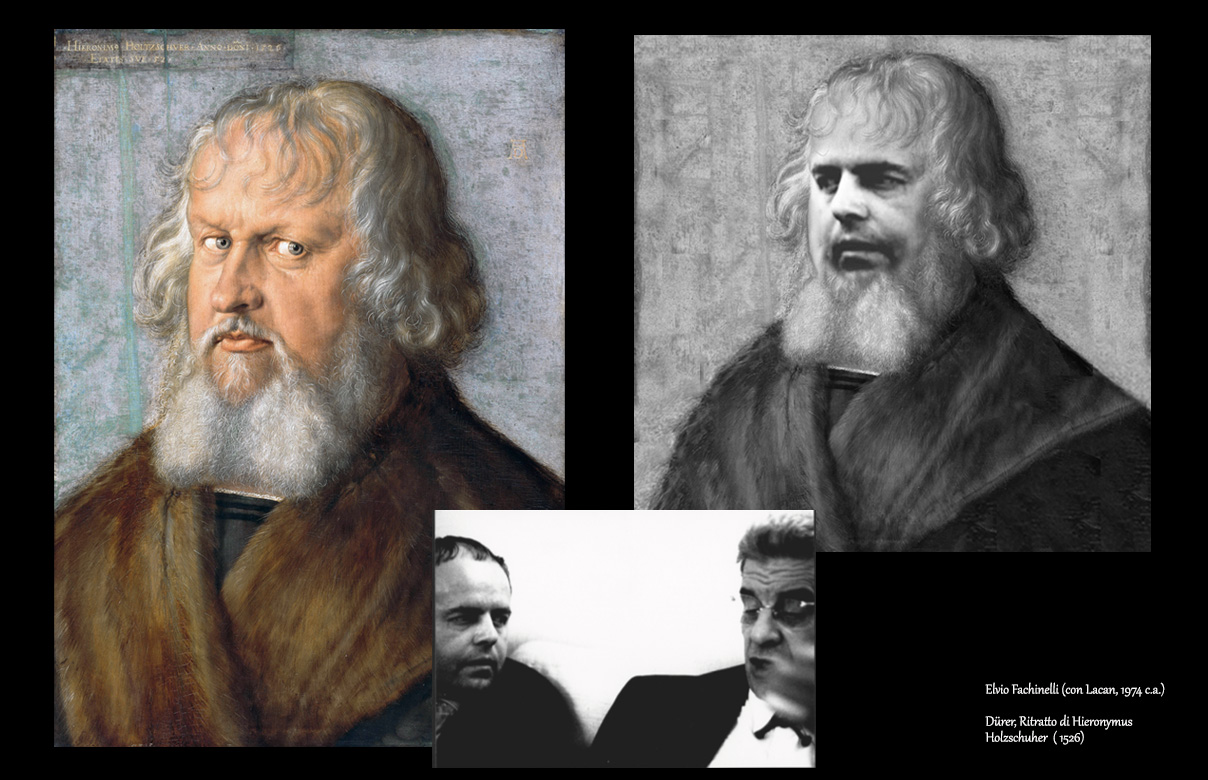
ESTASI LAICHE. INTORNO A ELVIO FACHINELLI

Firenze, San Salvatore al Monte, 18 settembre 2010


CONVEGNI, SEMINARI, CONFERENZE


LINKS
ASSOCIAZIONE FRANÇOISE DOLTO
LA PSICANALISI SECONDO SCIACCHITANO
JEP EUROPEAN JOURNAL OF PSYCHOANALYSIS
ISAP ISTITUTO DI STUDI AVANZATI IN PSICOANALISI - SEZIONE ITALIANA DI
IHEP INSTITUT DES HAUTES ÉTUDES EN PSYCHANALYSE

Walter Benjamin (1934), The Storyteller / Il narratore

All great storytellers have in common the freedom with which they move up and down the rungs of their experience as on a ladder. A ladder extending downward to the interior of the earth and disappearing into the clouds is the image for a collective experience to which even the deepest shock of every individual experience, death, constitutes no impediment or barrier.
“And they lived happily ever after,” says the fairy tale. The fairy tale, which to this day is the first tutor of children because it was once the first tutor of mankind, secretly lives on in the story. The first true storyteller is, and will continue to be, the teller of fairy tales. Whenever good counsel was at a premium, the fairy tale had it, and where the need was greatest, its aid was nearest. This need was the need created by the myth. The fairy tale tells us of the earliest arrangements that mankind made to shake off the nightmare which the myth had placed upon its chest. In the figure of the fool it shows us how mankind ”acts dumb” toward the myth; in the figure of the youngest brother it shows us how one’s chances increase as the mythical primitive times are left behind; in the figure of the man who sets out to learn what fear is it shows us that the things we are afraid of can be seen through; in the figure of the wiseacre it shows us that the questions posed by the myth are simple-minded, like the riddle of the Sphinx; in the shape of the animals which come to the aid of the child in the fairy tale it shows that nature not only is subservient to the myth, but much prefers to be aligned with man. The wisest thing—so the fairy tale taught mankind in olden times, and teaches children to this day—is to meet the forces of the mythical world with cunning and with high spirits. (This is how the fairy tale polarizes Mut, courage, dividing it dialectically into Untermut, that is, cunning, andÜ bermut, high spirits.) The liberating magic which the fairy tale has at its disposal does not bring nature into play in a mythical way, but points to its complicity with liberated man. A mature man feels this complicity only occasionally, that is, when he is happy; but the child first meets it in fairy tales, and it makes him happy.

Tutti i grandi narratori hanno in comune la libertà con la quale si muovono in su e in giù per i pioli della loro esperienza come su una scala. Una scala che scende giù fino al cuore della terra e svetta verso l'alto fino a sparire nelle nuvole è l'immagine per un'esperienza collettiva rispetto alla quale anche lo shock più profondo di ogni esperienza individuale, la morte, non costituisce né un ostacolo né un confine.
"E vissero per sempre felici e contenti," dice la fiaba. La fiaba, che è oggi il primo tutore dei bambini perché un tempo il primo tutore del genere umano, continua a vivere in segreto nel racconto. Il primo vero narratore è, e continuerà ad essere, il narratore di fiabe. Ogni volta che il buon consiglio era difficile, la fiaba lo aveva, e dove il bisogno era più grande il suo aiuto era più vicino. Questo bisogno è un bisogno creato dal mito. Questo bisogno è il bisogno creato dal mito. La fiaba ci racconta dei primi arrangiamenti fatti dal genere umano per svegliarsi dall'incubo che il mito gli faceva gravare sul petto. Nella figura dello sciocco ci mostra come il genere umano "fa il finto tonto" di fronte al mito; nella figura del fratello più piccolo ci mostra come le opportunità di ciascuno aumentino appena ci lasciamo alle spalle i primi tempi mitici; nella figura dell'uomo che parte per scoprire cos'è la paura ci mostra che possiamo vedere attraverso le cose di cui abbiamo paura; nella figura dell'astuto ci mostra che le domande poste dal mito sono semplici, come l'indovinello della Sfinge; nella forma degli animali che vengono in aiuto del bambino nella favola si mostra che la natura non è solo subordinata al mito, ma che preferisce di molto essere a fianco dell'uomo. La cosa più saggia - questo le fiabe hanno anticamente insegnato al genere umano, e lo insegnano oggi ai bambini - è incontrare le potenze del mondo mitico con astuzia e umore eccellente.  (È così che la  fiaba polarizza Mut, coraggio, dividendolo dialetticamente in  Untermut, sottocoraggio, vale a dire astuzia, e Übermut, umore molto alto). La magia di liberazione di cui dispone la fiaba non porta la natura in un gioco di tipo mitico, ma punta alla sua complicità con l'uomo liberato. Un uomo maturo sente questa complicità solo occasionalmente, vale a dire quando è felice: ma il bambino l'incontra prima nelle fiabe, e questo lo fa felice.
.


fiaba fiabe favola favole racconto racconti mito miti letteratura femminile maschile psicoanalisi psicanalisi scuola educazione istruzione didattica insegnanti docenti elementare media ultimo aggiornamento: 10 giugno 2010